Grandma’s Butter Fingers are delicate pecan cookies made from a simple buttery dough, shaped into little fingers, baked until lightly golden, and coated generously with powdered sugar. The version associated with the supplied Allrecipes recipe uses butter, flour, finely chopped pecans, confectioners’ sugar, vanilla, and a small amount of water, making it an especially straightforward old-fashioned cookie.
These are not the chocolate-covered candy bars sold under a similar name, and they are also different from peanut butter finger bars. Instead, this recipe belongs to the family of tender nut cookies often associated with holiday baking and recipes such as pecan fingers, Russian tea cakes, and similar powdered-sugar cookies.
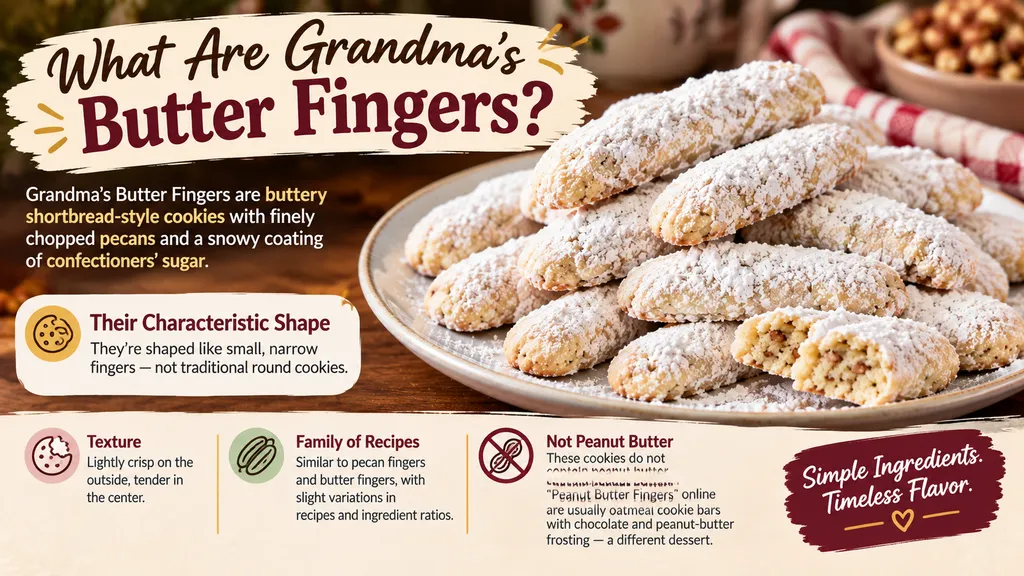
What Are Grandma’s Butter Fingers?
Grandma’s Butter Fingers are buttery shortbread-style cookies with finely chopped pecans and a snowy coating of confectioners’ sugar. Their characteristic shape is a small, narrow finger rather than a traditional round cookie.
The shape gives the cookies plenty of lightly crisp exterior while keeping the center tender. A similar family of recipes appears under names such as pecan fingers and butter fingers, so the exact ingredient ratios and names can vary between family cookbooks and regions.
One particularly useful distinction is that Butter Fingers do not contain peanut butter. Several recipes online called “Peanut Butter Fingers” are actually oatmeal cookie bars topped with chocolate and peanut-butter frosting, which is a completely different dessert.
Why These Cookies Are So Popular
The appeal is their simplicity: there is no complicated filling, frosting, or decorating step. Butter supplies richness, pecans add nuttiness and texture, vanilla rounds out the flavor, and powdered sugar provides the characteristic sweet finish.
They also have a strong connection with traditional holiday baking. One documented family version describes them as a Christmas cookie passed down through generations, while another historical recipe collection includes a very similar butter-and-nut cookie rolled in powdered sugar.
They work particularly well on a holiday cookie platter because their pale, powdered exterior contrasts nicely with darker chocolate, gingerbread, or fruit-based cookies.
Ingredients You’ll Need
For the supplied five-ingredient version, excluding water, gather:
- 3 sticks softened butter
- 3 cups all-purpose flour
- 1 cup finely chopped pecans
- 6 tablespoons confectioners’ sugar, plus additional sugar for coating
- 1 teaspoon vanilla extract
- 1 teaspoon water
The published recipe specifies softened butter rather than melted butter and finely chopped pecans rather than large pieces. Those details matter because the dough needs to hold its shape when formed into small fingers.
Ingredient Tips
Use real butter for the most traditional buttery flavor. Let it soften at room temperature so it blends smoothly with the dry ingredients.
Chop the pecans fairly fine. Large chunks can make the narrow cookies difficult to shape and can cause them to break more easily.
For the coating, confectioners’ sugar gives the cookies their characteristic soft, snowy finish. Keep extra sugar available because the cookies are rolled while still warm.
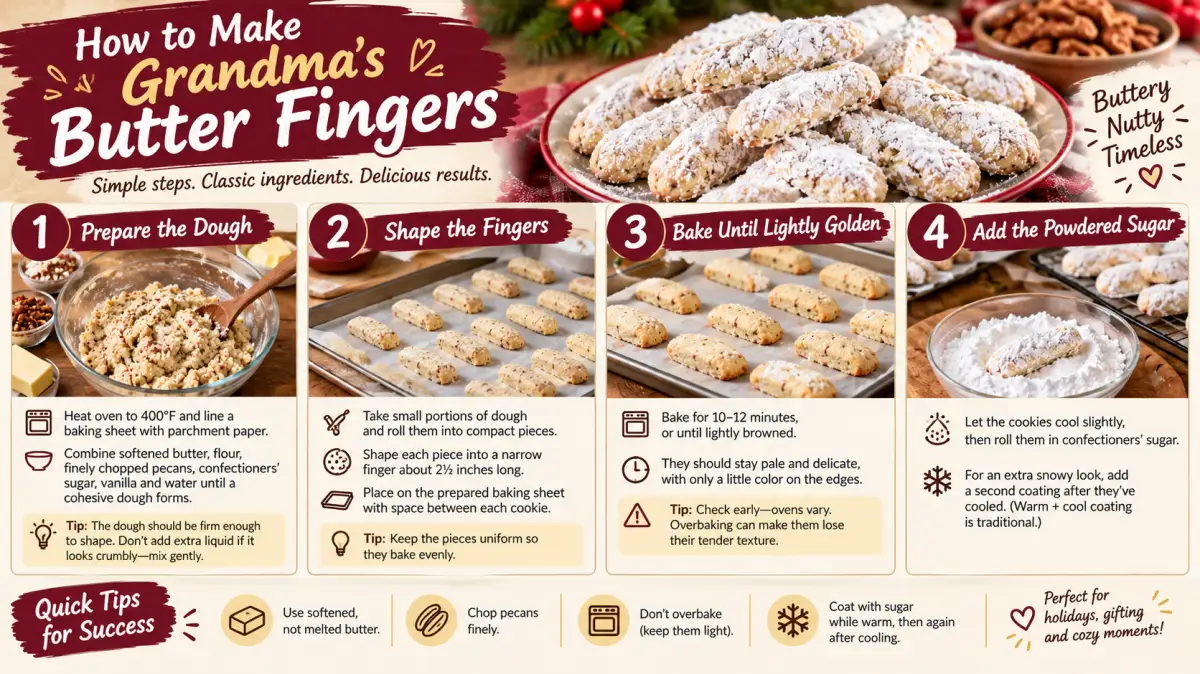
How to Make Grandma’s Butter Fingers
1. Prepare the Dough
Heat the oven to 400°F and line a baking sheet with parchment paper. Combine the softened butter, flour, finely chopped pecans, confectioners’ sugar, vanilla, and water until a cohesive dough forms.
The dough should be firm enough to shape rather than pour or scoop. Avoid adding extra liquid simply because the mixture looks crumbly at first; work it together gently before deciding that it needs adjustment.
2. Shape the Fingers
Take small portions of dough and first roll them into compact pieces. Shape each piece into a narrow finger approximately 2½ inches long.
Keep the pieces relatively uniform so they finish baking at the same time. A consistent size is more useful than trying to make every cookie perfectly identical.
Place the shaped cookies on the prepared baking sheet with enough room between them for even heat circulation.
3. Bake Until Lightly Golden
Bake for approximately 10–12 minutes, or until the cookies are lightly browned. The goal is not a deeply browned cookie; these are meant to remain delicate and pale with only gentle color around the edges.
Because ovens vary, start checking toward the shorter end of the baking range. Overbaking can take away some of the tender texture that makes this style of cookie appealing.
4. Add the Powdered Sugar
Allow the cookies to cool slightly, then roll them generously in confectioners’ sugar. The residual warmth helps the sugar adhere to the surface.
For an especially snowy appearance, a second coating after the cookies have cooled can be used. Similar traditional butter and pecan cookies are commonly coated while warm and coated again after cooling.
Five Common Questions About Butter Fingers
What are Grandma’s Butter Fingers?
They are small, buttery pecan cookies shaped like fingers and finished with confectioners’ sugar. They are closer to a nut-filled shortbread than to a peanut-butter cookie or candy bar.
Are Butter Fingers the same as Russian tea cakes?
They are closely related in style, but the names and recipes are not necessarily interchangeable. Both can feature a rich, crumbly butter-and-nut dough and powdered sugar, while Butter Fingers are characteristically shaped into narrow fingers in the version covered here.
Can I use walnuts instead of pecans?
Yes, walnuts can be used in this general style of nut cookie, although the flavor will change. Pecan fingers, walnut fingers, and other nut-based variations appear across older recipe collections, so walnuts are a reasonable variation when pecans are unavailable
Why are Butter Fingers rolled in powdered sugar twice?
The first coating gives the warm cookies their initial snowy layer, while a later coating can create a thicker, more visible finish. This two-stage approach is also found in other traditional powdered-sugar nut cookies.
How long do homemade Butter Fingers last?
Store completely cooled cookies in an airtight container at room temperature. A documented family version recommends keeping them airtight for up to one week, which is a practical target for maintaining their texture and flavor.
Expert Tips for Better Butter Fingers
Use softened, not melted, butter. Melted butter can change the dough’s consistency and make shaping less predictable.
Chop the nuts finely. Smaller pieces distribute more evenly and make it easier to form compact finger shapes.
Don’t chase dark browning. These cookies are supposed to be lightly colored. The edges can show a little golden color while the tops remain relatively pale.
Shape before baking. Once the dough is portioned, make the fingers reasonably uniform in thickness. Uneven pieces can finish at different rates.
Coat while warm, but handle gently. Freshly baked cookies are fragile. Give them enough time to firm slightly before rolling them through the sugar.
Keep the powdered sugar separate from the dough. The coating is meant to remain visibly snowy on the outside rather than disappear into the dough.
Variations, Serving Ideas, and Storage
The easiest variation is changing the nut. Walnuts can replace pecans, although pecans provide the classic Southern-style flavor associated with many versions of these cookies. Other historical recipes also show that similar finger cookies have been made with different nuts and flavorings.
For a subtle flavor change, almond extract can be considered in place of part or all of the vanilla, but use it carefully because almond extract is much more assertive.
Serve Grandma’s Butter Fingers alongside coffee, tea, hot chocolate, or a mixed holiday cookie assortment. Their delicate texture also makes them a good choice when you want a dessert that is sweet without requiring frosting or chocolate.
Once completely cool, keep the cookies in an airtight container at room temperature. Separate layers with parchment if the powdered sugar coating is especially generous. For gifting, allow them to cool completely before packing so trapped warmth does not create condensation.
Frequently Asked Questions
Can I make the dough ahead of time?
Yes, the dough can be prepared ahead when convenient, but keep it covered and chilled if you are not shaping it immediately. Allow it to become workable before forming the fingers.
Why did my cookies become hard?
Overbaking is a common cause of hard texture. Start checking around the lower end of the recommended baking time and remove the cookies when they are only lightly golden.
Should I use salted or unsalted butter?
Unsalted butter gives you more control over the flavor, especially in a recipe with so few ingredients. If using salted butter, avoid automatically adding extra salt unless the specific recipe calls for it.
Can I make these without pecans?
You can substitute another finely chopped nut, such as walnuts, but the finished cookies will no longer have the classic pecan flavor. If the goal is a traditional version, pecans are the better choice.
Pingback: McAlister’s Deli Reese’s Peanut Butter Pie: What to Know - Cravesprout.com