When people think about the world’s most famous soft drinks, Coca-Cola is usually one of the first names that comes to mind. It is sold in countries across the globe and has become part of everyday life for millions of people.
Scotland, however, has a different relationship with fizzy drinks. Here, a bright orange soda called Irn-Bru has developed a remarkable following and has, at various points, outsold Coca-Cola in the Scottish market.
For anyone unfamiliar with the drink, that might sound surprising. But Irn-Bru is much more than an alternative to cola. Its history, unusual taste and connection with Scottish culture help explain why it has remained so popular for generations.
A Scottish Drink With More Than 100 Years of History
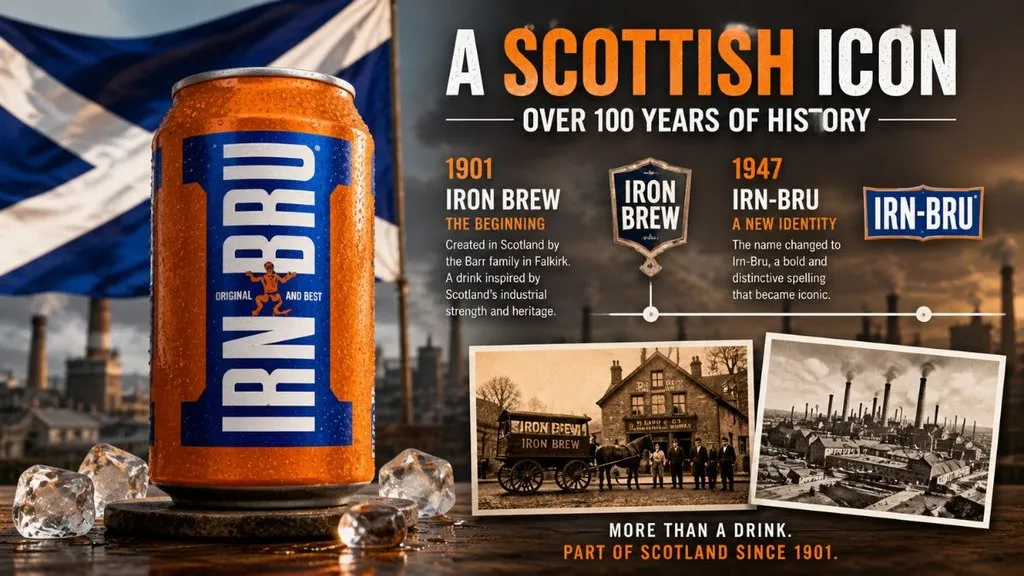
Irn-Bru’s story began in Scotland in 1901. It was originally introduced as Iron Brew, a name that reflected the industrial character of the time.
The drink was created by the Barr family, whose business was based in Falkirk. Scotland was undergoing major industrial development, and the name was closely associated with the country’s strong connection to engineering and steel production.
In 1947, the name was changed from Iron Brew to Irn-Bru. The new spelling was distinctive and eventually became one of the most recognizable parts of the brand’s identity.
More than a century later, the drink remains closely associated with Scotland.
What Makes Irn-Bru Different?
The first thing most people notice about Irn-Bru is its appearance. It has a bright orange color that immediately separates it from traditional cola drinks.
The taste is even harder to categorize.
Irn-Bru is made using a secret combination of 32 flavors, and there is no simple description that completely captures its taste. Some people notice fruity or citrus-like flavors, while others detect hints that remind them of bubblegum or vanilla.
That unusual flavor has become one of the drink’s defining characteristics. People who grow up drinking it often recognize the taste immediately, while visitors may find it difficult to compare with anything else.
Its uniqueness has helped give Irn-Bru a strong identity in a soft-drink market filled with familiar cola, lemon and orange flavors.
Why Is It So Popular in Scotland?
The success of Irn-Bru cannot be explained by taste alone. Its connection with Scottish culture is arguably just as important.
For many Scots, Irn-Bru is something they have known since childhood. It can be associated with family meals, school lunches, celebrations or trips to the local shop. Those everyday memories can turn an ordinary drink into something culturally familiar.
Coca-Cola, by comparison, is an international product. Its popularity is not tied to one particular country or community.
Irn-Bru has benefited from being seen as distinctly Scottish. Its identity has developed alongside the people who drink it, creating a connection that is difficult for an international competitor to reproduce.
Advertising Played a Role Too
Irn-Bru has also become known for its distinctive advertising style.
Over the years, its campaigns have often relied on Scottish humor, memorable characters and deliberately unusual ideas. Rather than presenting the drink simply as a refreshment, its advertising has frequently treated the brand as part of Scottish popular culture.
This approach helped make Irn-Bru recognizable even among people who did not regularly drink it.
The humor also gave the drink a personality. In a crowded soft-drink market, that personality helped it stand apart from more conventional advertising.
The Surprising Coca-Cola Comparison
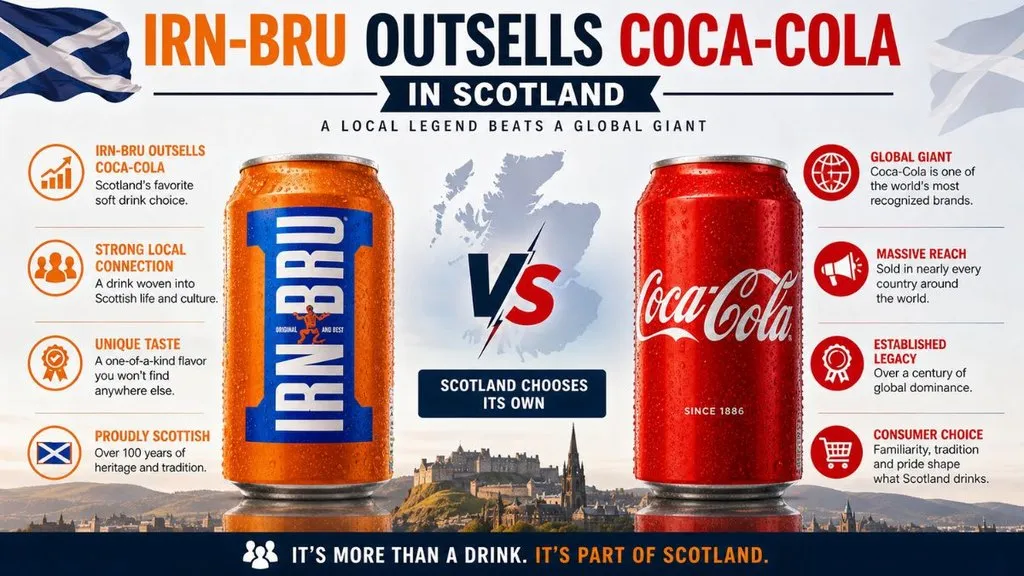
The fact that Irn-Bru has been able to outsell Coca-Cola in Scotland is significant because of Coca-Cola’s enormous international reach.
Coca-Cola has the advantage of being one of the most established beverage brands in the world. Yet local preferences can sometimes tell a different story.
Scotland provides a good example of how consumers do not always choose the biggest global brand. Familiarity, tradition and cultural identity can be powerful influences on purchasing habits.
The comparison between the two drinks therefore says as much about Scottish consumer culture as it does about soft drinks.
More Than Just a Fizzy Drink
Irn-Bru has gradually become part of the wider image of Scotland. It is often mentioned alongside other products and traditions that people associate with the country.
That does not mean every Scottish person drinks it or prefers it to Coca-Cola. Tastes naturally differ from person to person. However, its unusually strong cultural recognition is difficult to deny.
The drink’s longevity is also important. Few soft drinks can claim such a long history while remaining strongly connected to the place where they began.
Why the Story Matters
The story of Irn-Bru and Coca-Cola is ultimately a reminder that global popularity does not always determine local preferences.
A product can become successful not only because of its ingredients or marketing, but because people attach memories and meaning to it. In Scotland, Irn-Bru has benefited from more than a century of history and a strong sense of local identity.
That combination helps explain why a Scottish orange soda has been able to compete with one of the world’s most recognizable soft drinks.
For many people, Irn-Bru is not simply another option in the refrigerator. It represents a small but memorable part of Scotland’s food and drink culture — one that has survived changing tastes, generations and the arrival of countless competing beverages.